

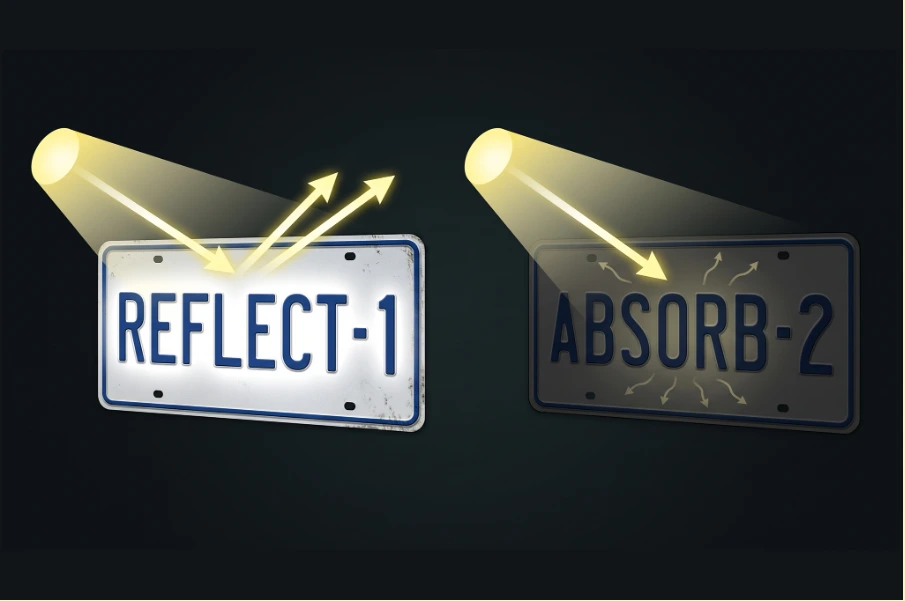
Similar surfaces can look different in photographs. A glossy finish may produce a bright highlight, while a dark coating can reduce the amount of light reaching the camera. Reflection, absorption, and imaging influence these effects.
These principles explain the appearance of automotive paint, glass, markings, and films—including specialized products like anti camera stickers for license plate.
What Happens When Light Reaches a Surface?
When light strikes a material, some of it may be reflected, some absorbed, and some transmitted. The proportions depend on the material, surface structure, and wavelength of the incoming light.
Reflection redirects light away from a surface. Absorption converts part of the incoming optical energy into other forms, usually heat. Transmission allows light to pass through a material.
A single automotive component may exhibit all three behaviors at once. Their balance shapes photographs and influences how materials are assessed in practical applications.
Reflection in Automotive Materials
Reflection can be diffuse or specular. A matte surface scatters light across many directions, producing a relatively even appearance. Polished metal and glossy paint create more directional reflections, which can appear as concentrated highlights.
Retroreflective materials behave differently. They return a substantial portion of incoming light toward its source, which is why reflective markings can appear especially bright when a camera is positioned near an illuminator.
These effects are relevant to products described as anti camera stickers for license plate. Alite presents Nanofilm Ecoslick as an optical film intended to modify how selected plate characters respond to infrared illumination. This illustrates how thin layers influence light interacting with printed materials.
How Light Absorption Changes Appearance
Absorption occurs when a material takes in part of the incoming light rather than returning it toward an observer. Dark surfaces often absorb more visible light than pale ones, although behavior depends on the specific pigment and wavelength.
A coating may appear dark under ordinary lighting but respond differently outside the visible spectrum. For example, infrared reflectance cannot always be predicted from the color perceived by the human eye.
This distinction matters because camera systems may use visible illumination, infrared illumination, or a combination of both. Images can therefore differ without physical changes.
Why Reflection and Absorption Are Not Opposites
Reflection and absorption are competing pathways for incoming light, but they do not describe every possible outcome. Transparent materials also transmit light, and textured surfaces scatter it.
Engineers evaluate several characteristics when selecting optical materials:
- Reflectance: The fraction of incident light returned by a surface.
- Absorptance: The fraction of incident light taken into the material.
- Transmittance: The fraction that passes through the material.
- Wavelength response: How these fractions change across the light spectrum.
- Surface geometry: How texture and viewing angle influence reflected light.
- Layer construction: How coatings and substrates interact optically.
Together, these measurements provide a more useful description than a simple label such as shiny or dark.
Camera Sensors and Recorded Contrast
A camera does not measure surface color directly. It records light reaching the sensor after interaction with the subject, lens, and any filters.
Exposure settings influence whether bright regions retain detail or become saturated. Insufficient exposure can hide distinctions in darker areas. Image processing then adjusts contrast, sharpening, and tonal balance.
For printed characters, readability depends on the difference between the recorded appearance of the characters and their background. Changes in illumination or optical response can alter that difference, even when the printed design remains unchanged.
Evaluating Optical Films Consistently
Reliable material comparisons require controlled lighting and camera settings. Engineers can examine the same sample under different wavelengths while keeping viewing geometry consistent.
They also consider durability. Exterior films may encounter moisture, dust, temperature changes, and repeated cleaning. Protective construction must preserve the intended optical behavior over time.
Testing multiple conditions reveals how materials and measurement setups interact.
Conclusion
Reflection redirects light, while absorption takes in part of its energy. Transmission, scattering, and wavelength sensitivity add further complexity to how automotive surfaces appear.
From reflective registration plates to specialized films offered by Alite, these principles explain why surface materials and camera lighting must be considered together. Understanding their differences supports more accurate material evaluation and automotive imaging.
